해설 「풍경다리, 그림꼬리」“Landscape_Dari_Footnote, Painting_Endnote_Kkori”
조주리Juri Cho
각주
1. 풍경, 화
회화의 역사에서 풍경은 언제나 나무와 숲, 산과 돌, 물과 바다로 존재해왔고, 아주 조금씩만 그 위상과 다름을 생성시켜왔다. 다소 관습적인 자태로 자연의 모습이나 마을 정경이 도상적 인물이나 사건의 후경으로써 멀치감치 물러나 있었던 시간이 그렇지 않았던 때 보다 비할 수 없이 길었던 것만은 사실이다. 공기처럼 편재하거나 무대의 백 드롭처럼 서있던 자연에 ‘풍경’(Landscape) 이라는 이름을 덧붙인 것은, 그러니까 상당히 근대적 명명이며, ‘풍경화’를 프론트 장르로써 독립시킨 것 또한 서구적 기획의 일환이다.
긴 시간 동안 중국회화로부터 영향을 받은 한국 회화사에서의 사의(寫意)적 풍경 전통과 실경 산수로의 점진적 이행, 르네상스 이후 이탈리아, 영국, 프랑스, 네덜란드 등지에서 발달한 고전주의적 화풍과 이상주의적 풍경 설계, 오늘날 회화에서 소비되고 있는 풍경 개념의 변화상을 예리하게 변별하거나 시대사적으로 추적하는 일은 그러나, 무의미하게 느껴진다. 오늘날 회화 속의 자연은 풍경은 내용적으로는 정치적이며, 시각적으로는 모조模造적이지만, 넒은 관점에서 본다면 여전히 인본주의적 틀 안에 놓인 개인의 편집술이며, 내면이 투영된 장막이다.
풍경이 풍경화로 이행된 것, 즉 그 이전에는 그렇지 않았던 점을 거꾸로 되새길 필요가 있다. 가령 18세기 영국인들은 이탈리아풍 풍경화가 유행하면서 자국의 시골 모습도 그림의 주제가 될 수 있다는 것을 각성하게 되었다. 클로드 푸생 스타일의 전원 풍경화를 정전 삼아 영국의 기후와 풍토, 사회에 적합한 풍경화 스타일을 만든 과정을 떠올려본다면, 자연을 캔버스에 옮겨온 것이 매우 인위적인 가공이자, 당대의 건축과 조경, 문학과 연결되는 문화적 산물, 제도화의 과정이었음을 이해 할 수 있다. 통신, 디지털 기술, 세계에 대한 물리적 경험과 가상적 체험의 총량 또한 오늘날 자연과 도시 풍경을 이미지로 생산하고 소비하는 데 변별점을 제공한다. 그러나 풍경이 풍경화로 재편되는 과정에서 가장 핵심적인 매개항은 작가라는 점. 그것만은 변치 않는 사실이다.
2. Jpeg
-joint photographic coding experts group
JPEG 위원회에 의해 개발되었다. 사진 등의 정지화상을 통신에 사용하기 위해서 압축하는 기술의 표준이다. 이미지를 만드는 사람이 이미지의 화질과 파일의 크기를 조절할 수 있다. JPEG는 풀 컬러(full-color)와 그레이 스케일(gray-scale)의 압축을 위하여 고안되었으며, 사진이나 예술분야의 작업에서 장점을 나타낸다. GIF와 함께 인터넷에서 가장 자주 사용된다. GIF에 비해 데이터의 압축 효율이 더 좋다. 또한 GIF는 256색을 표시할 수 있는데 반해 JPEG는 1,600만 색상을 표시할 수 있어 고해상도 표시 장치에 적합하다.
또 한 가지 JPEG의 유용한 점은 이미지를 만드는 사람이 이미지의 질과 파일의 크기를 조절할 수 있다는 것이다. 예를 들어, 이미지가 큰 파일을 아주 작은 크기의 파일로 압축하려 하면 이미지의 질이 그만큼 떨어지게 된다. 그러나 JPEG 압축 기술을 이용하면 이를 적절히 조절하여 이미지에 손상에 가지 않도록 이미지를 압축할 수 있다.
출처: 네이버 지식백과 (원전: 두산백과), 검색어: JPEG
3. 돌,석
지방에서 신도시로, 이곳 저곳 빈번하게 삶의 거처를 옮겨온 나에게는(필자를 지칭함) 돌은 지질학적 분류에 따른 것이라기 보다 북한산의 독바위와 같은 ‘자연물’이기도 하고 현대적 건물의 파사드를 이루는 대리암과 같은 번쩍이는 건축적 ‘재료’이기도 하고, 변두리 주택가 특유의 회색조 경관을 이루는 시멘트나 벽돌과 같은 ‘자재’이기도 하다. 어떤 면에서는 집도 길도 산도 모두 돌인 셈이다. 그러니까 돌은 어떤 물성의 교집합이기 보다, 이 세계를 구성하는 가장 경고하고 거대한 합집합 덩어리다.
자연물/인공물로서의 돌은 무의식, 그것이 전달하는 미묘한 시그널을 무시할 수는 없다. 한 때 옹골찬 밀도로 우뚝 솟았던 돌은 도시문명을 일으키고 들과 강을 지지하는 쐐기 였지만 부단히 패이고 깎이고 갈려져, 이내 돌 그 자체의 오롯한 총체성이나 그것이 뿌리박혀 있던 장소성을 상실하여 우리 앞에 처리해야 할 도시의 잔여물로, 산업 폐기물로 남겨졌다.
출처: <강홍구의 사진과 돌의 무의식>, 『리서치, 리:리서치』, 조주리 저, 2016, 서울:물질과비물질
3. Rocks
For someone who has frequently moved from provinces to new towns, and between Korea and overseas, rock resist simply falling under a geological category. Rather, they become a part of ‘nature’ in the likes of the protruding boulder along the Bukhan Mountain ridge; or architectural ‘material’ conveyed by the gleaming marble façade of a modern high-rise; or building ‘blocks’ in the forms of bricks and cement that render the ashen landscape of a typical suburban residential district. In a certain sense, houses, roads and mountains are all essentially rocks; thus, rather than being a mere crossing of properties, rocks collectively embody the entire world as the most enduring and colossal lump.
The subtle signals of unconsciousness emitted from rocks in their natural and artificial forms cannot be simply brushed away. The dense rocks were once chief pillars of ancient civilizations and wedges anchoring field sand rivers. It was the relentless furrowing, paving and cracking that robbed these rocks of their integrity and deep-rooted sense of place, and reduced them to urban residues and industrial wastes harrowingly scattered about.
<Photography of Kang Hong-Goo and the Unconsciousness of Rocks>, 『research, re: researched』, Written by Juri CHO, Translated by Jiyoung Kim, 2016
4. 세르비아
오늘은 조금 생소할 수도 있는 여행지, 발칸반도에 대해 소개해 드리겠습니다!
발칸반도란 유럽 남부에 위치한 반도로, 이에 속하는 국가로는 그리스, 알바니아, 불가리아, 루마니아, #세르비아, 몬테네그로, 슬로베니아, 크로아티아, 보스니아-헤르체코비나, 마케도니아가 있답니다.
세르비아의 대표적 관광지는 공화국 광장, 스카다리야 시장, 그리고 이 둘 사이에 있는 스카다리야 거리입니다. 스카다리야 거리는 #베오그라드의 예술의 거리로, 흔히 말하는 보헤미안들의 주요 무대라고 합니다. 예쁜 카페와 음식점은 물론이고, 다양한 꽃들과 건물들의 페인팅이 조화로운 곳이라고 하니 사진찍기 좋을 것 같네요~
출처: 네이버 블로그 ‘매일 25분 엔구 화상영어’- 현지인 도움 받기, 발칸반도 여행정보, 작성자: Andoo님
5. 채석,장
“용마폭포공원에 큰 변화가 생긴 것은 1961년부터다. 일제강점기 종로구 창신동 채석장에서 건설공사에 쓸 돌들을 채취했는데 해방 이후 모자라는 골재를 충당하기 위해 이곳 용마산이 서울시의 새로운 골재 채취장이 되었다. 1988년까지 약 27년간 채석장으로 이용된 이 자리는 이후 1993년 용마돌산공원으로 문을 열었고, 1997년 용마폭포공원으로 명칭이 바뀌었다. …… 그렇게 한때 골재 채취장이었던 용마산 암절벽이 지금은 동양 최대의 인공폭포로 변모해 있다. 51.4m의 거대한 용마폭포를 양옆에서 호위하듯 좌로는 청룡폭포, 우로는 백마폭포가 감싸 돌며 독특한 지형과 함께 청량한 비경을 보여준다. 폭포수의 장관과 함께 그 밑에는 약 700평의 연못이 펼쳐져 있다.”
출처: “동양 최대 폭포로 변신한 옛 채석장”, 서울살이 길라잡이 서울& 취재팀, 김원정 중랑구청 홍보담당관 주무관
6. 여행,기
『동방견문록』은 유럽에서 성경 다음으로 많이 읽힌 책이라는 수식어가 붙은 중세 최고의 베스트셀러다. 동방견문록이라는 제목은 이 책이 인상적인 장면을 위주로 기록한 여행기라는 느낌을 준다. 실상은 다르다. 원제는 《세계의 서술(Divisament dou Monde)》이다. 폴로는 유럽인들이 가보지 않은 지역에 대한 총체적 정보를 담으려고 했다. 지리적 위치, 주민들의 종교 및 생활습관, 언어, 정치적 상황 등을 자세하게 묘사했다. ‘낯선 괴담의 창작’이 아니라 ‘체계적이고 정확한 정보의 전달’이 구술의 목표였다는 뜻이다.
폴로는 구술 당시부터 자신의 책이 황당무계한 이야기 취급을 받을 것이라고 예측한 듯하다. 그래서 책 곳곳에 ‘보지 않고 믿을 사람은 없을 것이다’ ‘들어도 믿기 힘들 정도다’ ‘여러분은 이 점을 알아야 한다’는 문구를 여러 차례 집어넣었다. 그리고 ‘내 증언은 아무런 거짓이 없는 올바르고 참된 것’이며 ‘직접 보거나 진실이라고 들은 갖가지 경이를 (내가 구술하고 루스티첼로가) 받아 적도록 하지 않음으로써 사람들에게 이런 사실들을 알리지 않는다면 그것은 너무도 커다란 죄악이 될 것’이라고 단언했다.
출처: 마르코 폴로의 동방 견문록, 장원재 박사의 ‘그것이 알고 싶지? 『한국경제신문』, 2017.4.17
7. 하얀
오래 전, 하얀 눈에 관한 셀 수 없이 많은 표현을 갖고 있다 했던 이누이트족의 이야기를 들으며 특정한 자연환경과 소수민족의 언어가 조응하며 만들어 내는 풍부하고도 섬세한 빛의 이미저리에 대해 감흥과 동경을 갖지 않을 수 없었다. 이는 실상 교착어 성격의 에스키모 언어 체계를 이해하지 못한 서구 인류학자의 몰이해로 벌어진 과잉 해석으로, 눈에 둘러 쌓여 살아간다고 해도 이누이트족이 흰색에 관한 수백 개가 넘는 단어를 구사하지는 않는다고 한다.
출처: 『백색 광시곡』, 조주리 저, 2017
7. Upon WHITE
A long time ago, I was told the story of the Inuit, how they have countless expressions for the white color of snow. I was inspired by the way the natural environment and a language of a people can consolidate to create the intricate imagery of light. However the truth was, they did not have hundreds of words for white even though they are surrounded by pearly snow. This idea was the result of the western anthropologists’ misunderstanding and over-analysis of the agglutinating language system of the Eskimos.
『RHAPSODY IN WHITE』, Juri CHO, 2017
8. 기하학,적
기하학: 도형 및 그것이 차지하는 공간의 성질에 대하여 연구하는 수학의 한 부문. 고대 오리엔트에서 시작하여, 초등 기하학은 그리스의 유클리드에 의해 집대성되었음. 현재는 이것을 더 발전시켜 해석 기하학·미분 기하학·사영 기하학(射影幾何學)·위상 기하학(位相幾何學) 등 다양한 내용·방법을 가지고 있음.
기하학적: 기하학에 관련이 있거나 바탕을 두고 있는. 또는 그런 것.
출처: 구글 딕셔너리, 검색일: 2020. 6.7
9. 유원지
도시 공간이 커져가고 보다 밀집해 지면서 자연환경에 대한 요구는 증가되었다. 16세기와 19세기 사이에 유럽과 미국의 도시들은 공공공지, 녹지, 광장, 퍼레이드 광장, 프로미나드, 퍼블릭 가든 등을 조성하여 도시환경을 개선하였다. 19세기 무렵 유럽의 많은 도시들은 규모가 커졌으며 산업화되었다. 인구의 많은 부분이 이러한 산업도시에 살았으며 비도시 지역의 대부분은 농촌이었고 원생자연은 드물게 되었다. 도시 내에서 자연의 공간은 원생자연의 문명화된 재생이었으며 이로운 것으로 간주되었다.
우리나라는 1888년에 인천의 각국 거류지 내에 각국공원(各國公園)이 조성된 이래 일본공원[東公園, 1890], 독립공원(1897년), 화성대공원(和城臺公園), 탑골공원, 부산 용두산공원, 대구 달성공원 등이 뒤를 이어 조성되었으나 일제강점기와 한국전쟁을 거치면서 체계적인 도시공원의 조성은 이루어지지 못하였다. 그러나 1960년대 들어서면서 급격한 산업화와 도시화로 인하여 깨끗하고 푸른 휴식공간에 대한 필요성이 높아지고, 국민소득 및 여가시간의 증대와 가치관의 변화 등으로 인해 공원에 대한 요구가 증가하였다.
출처: 온라인 한국민속대백과사전, 키워드: 유원지, 공원, 집필자: 이자원 (성신여자대학교 지리학과), 2009
10. 사생 (寫生)
스케치의 번역어. 대상을 신속히 묘사하는 현장에서의 습작을 뜻한다. 원래 중국에 있어서 사생(xiesheng)은 화조화(더러는 산수화)로, 상상에 의지하지 않고 대상을 직접 묘사하는 것을 말한다. 출처: 미술대사전 용어편, 1998, 한국사전연구사 편집부
“사생의 의미를 이해하기 위해 비교해서 생각할 수 있는 것은 그리스 조각과 로마 조각의 차이이다. 그리스 조각은 시각화된 현상을 이상화(理想化)한 모습으로 나타내었으나, 로마 조각은 사물을 현상적(現象的)으로 파악하였으며, 이것이 발달하여 르네상스시대에 들어오면 시각화된 것을 묘사하기 위한 과학적 고찰에 의해 사생에서의 원근법과 명암법이라는 화법을 확립하게 되었다. 이러한 화법을 기초로 사생의 내용도 객관이 주관에 지각되어 마음 속에 비친 것을 파악하려고 하는 방향으로 바뀌었다. 말하자면 사생(寫生)에서 사심(寫心)으로 인간적인 발전을 한 셈이다. 그래서 오늘날 화가가 사생한다는 것은 회화화하기 위한 사상(事象)의 구조적인 이해에 그치지 않고, 가장 인간적인 내용이 담긴 것으로까지 확대시켜서 파악하는 행위로서 이해해야 한다. 그런 의미에서 ‘사생’에 해당하는 영어인 ‘drawing from life’는 사생의 말뜻을 단적으로 나타낸 것이다.”
출처:온라인 두산백과
미주
1. 최가영 Kayoung Choi
작가의 이전 전시 제목은 <보이지 않는 것들의 그림자>, <한 조각의 무지개를 찾아서> 그리고 <쉽게 찾은 풍경>등이다. 보이지 않는 것, 가려지고 버려진 것, 재현 불가능의 것들을 찾아 나서는 작가적 여정은 일차적으로는 역사화 된 말과 이미지에 대한 권태로움 때문일테고, 한 켠에서는 여행과 통신의 발달에도 불구하고 가본 적 없는, 혹은 가보기에 사나운 곳들을 향한 동경, 그리움, 강박에서 비롯된 것일지 모른다.
모든 것이 지나치게 많은 질량으로 두텁게 분포해 있는 오늘날. 일상으로부터 엑소더스란 그와 반대로 희박하고 희미한 풍경을 정성스레 찾아나서는 일이자, 부러 성가신 룰과 창작 프로세스를 고안해 내는 일을 수반한다. 이를테면, 오늘날 예술가의 미션이자, 시각 이미지를 창안하는 직군의 전문인들이 수행하는 방식이다.
욕망하는 것들을 선명하게 오려내고, 테두리 바깥의 풍경을 삭제하거나 또 다른 것으로 채워넣기. 작가의 편집술은 대체로 캔버스의 화면을 비어 있는 정전으로 놓고, 작가의 신체적 움직임을 모터로 삼는 채워 나가는 고독한 행위이다. 모두, 시지각적 사고에 기반한 실험들이다.
작가의 그림 그리기는 다른 것일까? 대체적으로는 그렇다고 할 수 있고, 국부적으로는 조금 다르다고 할 수 있다. 그것은 동양화에서 출발한 기초적인 ‘사생’의 습관과 그와는 무관한 개인의 풍성한 감각 사이의 배치, 충돌 때문일 것이다. 최가영의 풍경 그림의 과정은 정보 기반의 대화와 서신 송수신 행위, 개인의 적극적 상상이 강력하게 개입된 시간 선상의 일에 가깝다. 기다림과 소통의 과정을 풍성하게 늘려 놓고, 상상과 최면의 심리적 상태를 투영함으로써 그리기 이전과 화면 바깥에서 흐르는 시간들을 중계하는 것처럼 보인다. 때문에 '직접 본 적 없는 것을 그려내는 작업'으로만 압축되고 만다면 필시 누락되는 것들이 있을 것이다. 개인의 이야기를 압축한 회화적 생성과 그 결과값들은 JPEG처럼 소실없이 압축되지 못하며, 폴로의 여행기처럼 미지-과잉 상태를 견딜 수 없을 것이며, 백과사전처럼 정확하지도, 여행 블로그의 후기처럼 산뜻하지도 않을 것이다.
전시는 빛나는 수정처럼 결정화된 풍경이어서 더 없이 아름답고 평온하다. 상상과 재현을 오가며 화면을 채워나가는 화가로서의 기법과 전시 공간 전체를 구축해나가는 시도들은 이미 벌써 완숙하다. 전시장에서 평면과 입체적인 설치 물을 통해 어쩌면 작가가 재현하고, 중계한 것들은 풍경자체라기 보다 그리는 행위의 다변적 과정들, 장소 뒤로 증발된 이야기, 정당한 오해들, 붓질로 입혀진 이야기, 필연적으로 꾸며낸 감상과 같은 알 수 없는 일일 것이다.
작가에게 트로피처럼 반짝거리는 말을 건네는 대신, 의구심 어린 순진한 질문과 오해 범벅의 감상이 도움이 될지도 모르겠다.
2. 해설노트 : 풍경다리, 그림꼬리
직업적으로 한 해에 서너 편의 전시 서문, 예닐곱 편의 작가론, 스무 개 이상의 작품 설명을 쓴다. 작가론의 경우 얼마간은 서로의 존재를 알고 있는 이로부터 의뢰 받은 글 하나 둘, 미술 기관에서 의뢰 받은 글 서넛, 이따금 생면부지인 이를 위한 글을 하나 정도 쓰는 수순이다. 특별히 거절할 이유가 없다면 전시의 주기에 너무 뒤쳐지지 않을 속도로 글을 쓰는 편이다. 소통의 방식과 순서는 이렇다. 창작 노트나 그간의 작업 포트폴리오에 드러난 작가의 생각, 그 사람의 언어와 사고의 특성, 시각화된 방식의 방법론을 확인하는 것, 한 두차례 만나서 궁금한 것들에 대한 확인과 새로운 발견을 토대로 대화 나누기, 가능한 첫 만남에서 직관적으로 받은 인상과 정제되지 않은 상태의 생각들로부터 글 제목과 쓰기의 전략을 대략적으로 정해두는 것, 이삼 주 간 상대의 상황과 호흡에 맞추어 글을 써서 상대의 동의와 의견을 구하는 일.
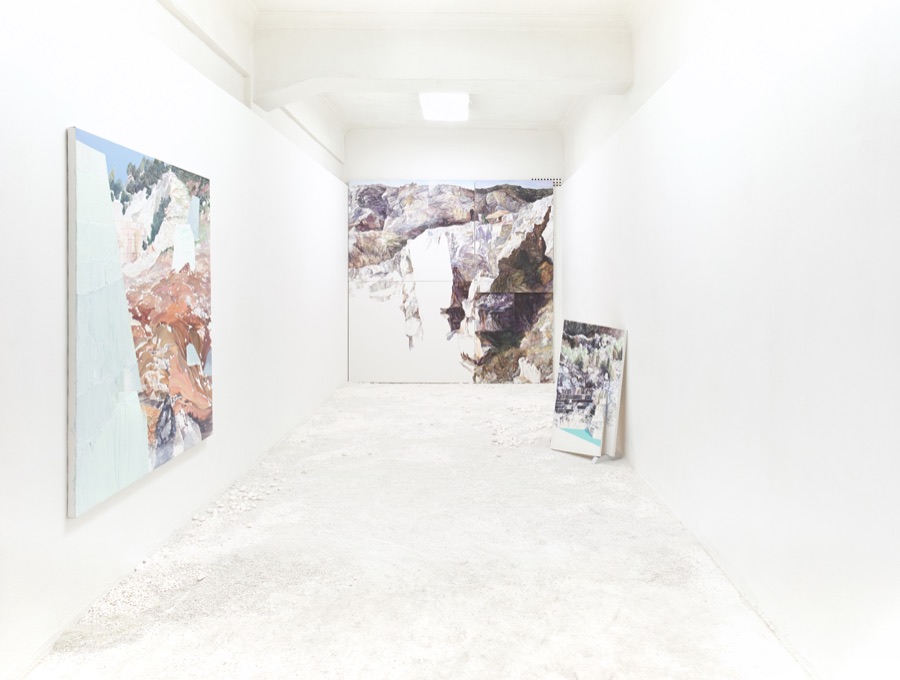
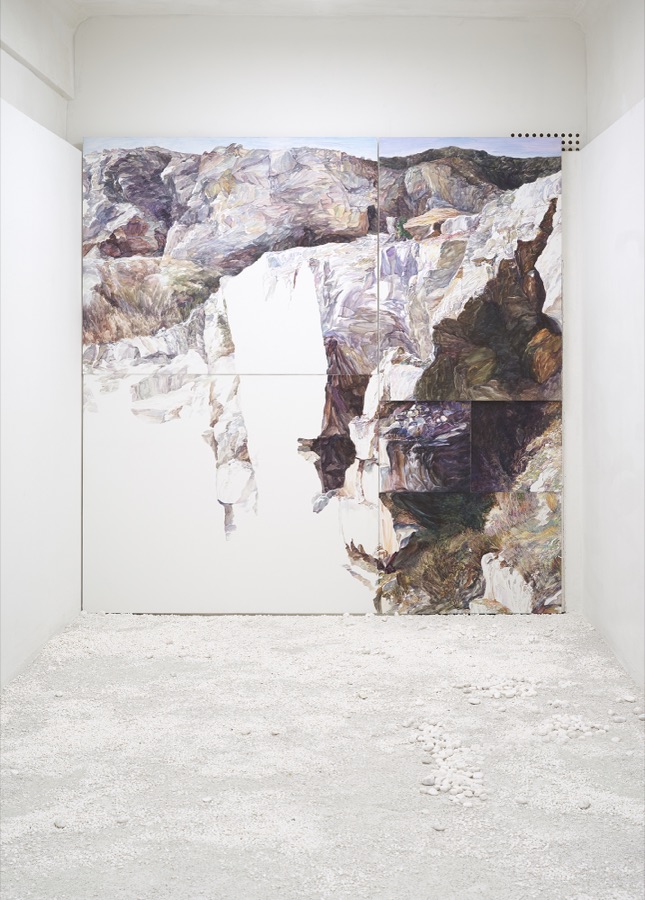
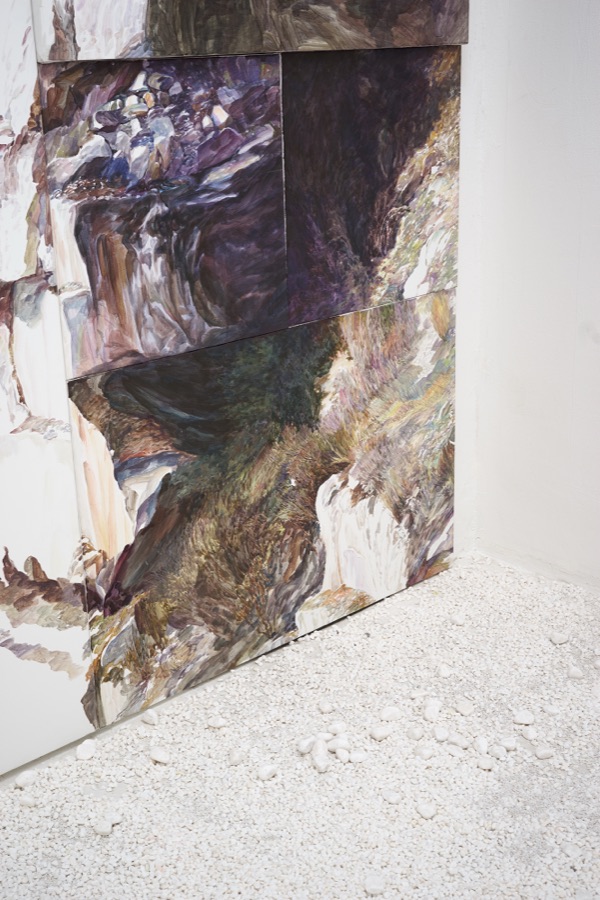
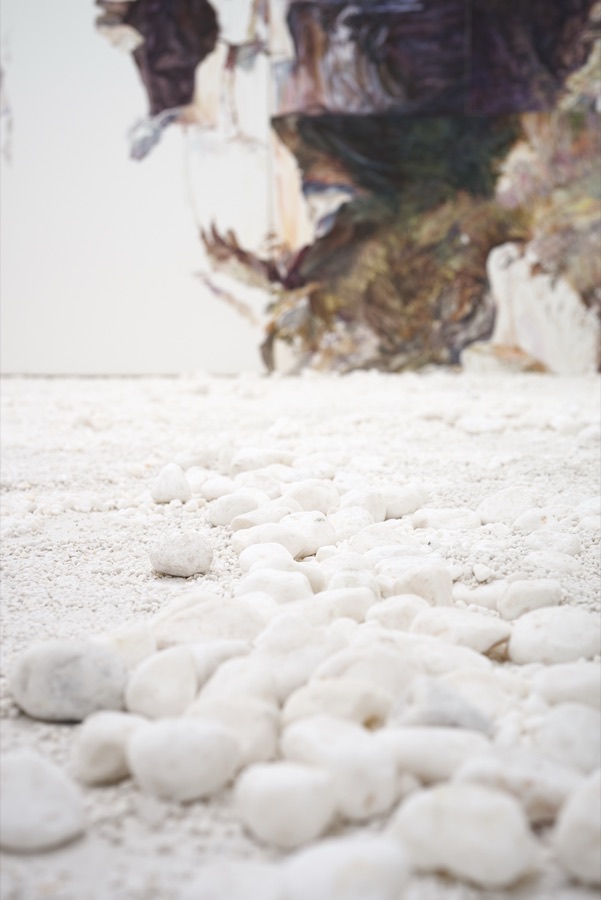
최가영의 개인전<세르비아의 산, 채석장, Венчац>( 2020.05.07-05.26 공간 형) 도록제작을 위해 의뢰 받은 글은 각주와 미주를 본 따 구성된 일종의 해설서이며, 앞서의 판단과 구상 과정을 거쳐 집필되었다. 아마도 도록의 서문 자리에는 드러나지 않을 표제 <풍경다리, 그림꼬리>는
도록 편집상의 페이지네이션을 확인하고 이리저리 조합해 본 말들의 덩어리다. 다리는 각주(footnote), 꼬리는 미주(endnote)에 각각 대응되는 우리말인데, 이를 다시 풍경-그림에 접합시킨 그런 말장난이다. 서문이나 발문의 형태보다는 응당 최가영의 글과 그림을 보완 설명해주는 그런 말들을 찾아가는 과정이었다. 작가 자신과 메일로 이국의 사진을 보내온 M과의 관계로부터 그와 유사한 거리를 전제한 또 하나의 레이어를 쌓아나가는 엉뚱한 해설봇bot 같은 글쓰기 상태를 떠올렸던 것이다. 짤막한 글에 나오는 열 개의 단어는 다시 이전에 썼던 글들로부터 찾아낸 동일한 단어 파편들과 마르코 폴로의 여행기에 관한 야트막한 깊이의 인터넷 기사들, 채석장과 유원지 같은 특정한 단어들, 즉 온 세계 모든 도시에 있을 법한 폐허와 낭만의 장소성을 박제한 듯한 박물지적 문장들을 끌어오게 되었다.
어쩌면 최가영과 M 사이에 이루어진 소통의 총량과 우정의 밀도에 비해 나와 작가 사이에 주고받은 대화의 질과 상호 이해란 그보다 훨씬 부박한 수준이었을 것이다. 그럼에도, 그림이 글이, 그려지고 써지는 것은 이 세계의 일이다. 마르코 폴로의 여행기가 실증적인 기록이었는지 의심할 필요없이 즐길 수 있는 문학이 된 것처럼 말이다. 세르비아의 채석장 작업은 그 자체로, 이전 작업의 시퀄이자 다음에 등장할 어떤 시리즈의 프리퀄이 될 텐데, 궁금하다. ‘없는 곳’과 ‘없어진 곳’의 의미 용례가 살짝 다른 것처럼, 다음 번 작업에서 ‘있는 곳’과 ‘있게 된 곳’의 풍경과 풍경의 간극이. 그리고, 겪어본 적 없는 시공에 대한 애달픈 노스탤지어가.
Landscape_Dari_Footnote, Painting_Endnote_Kkori *Dari is the Korean word for bridge, and kkori is the Korean word for tail. Each is a play on the Korean words corresponding to footnote and endnote.
(Commentary: Juri Cho)
Footnote 1. Landscape Painting In the history of painting, landscape has always existed as images of trees and forests, rocks and mountains, and water and sea. The status of landscapes and its defining characteristics have evolved only slightly. Natural images or village scenes have served as customary background of iconic figures’ portraits or images portraying certain events for much longer than as the main subject of paintings. The term “landscape” began to denote nature ubiquitously present like air or standing like a stage backdrop as a result of a rather modern practice. The very act of separating landscape painting as a leading genre of art was also part of a Western practice. Korean painting has a long history of having been influenced by Chinese painting. The focus of Korean painting gradually shifted from the tradition of painting landscapes in one’s mind and imagination to painting real scenery landscapes. In Europe, classical paintings and idealistic positioning of landscape developed and flourished in post-Renaissance Italy, England, France, and the Netherlands. The concept of landscape also evolved in contemporary paintings.
Yet, it seems meaningless to keenly distinguish such changes or trace the evolution by period. Natural landscape in today’s paintings is political in content and imitative visually. However, from a broader perspective, landscape is still a subject open to individual interpretation and artistic intervention within the greater boundary of humanistic framework, and it is also a canvas reflective of one’s introspection. It is necessary for us to ruminate on the fact that landscape “became” a genre, that there was once a time when landscape was not a subject matter for painting. In the 18th century, English were inspired by the popularity of Italian-style landscape paintings and realized that bucolic landscapes of England can also become subject matters for paintings. Think about how English painters took Claude Lorrain and Nicolas Poussin’s style of pastoral landscape paintings and created a landscape painting style reflective of the British climate and society. It becomes clear then that transferring nature to the canvas as painted images was a very artificial process, a cultural byproduct tied to the architecture, landscaping, and literature of the time, as well as part of institutionalization.
Telecommunication, digital technology, and the sum of physical and imaginary experiences of the world also provide points of distinction in creating and consuming images of today’s natural and urban landscapes. Nonetheless, the fact that the artist is the key medium in the process of landscape becoming landscape paintings remains unchanged.
2. Jpeg - joint photographic coding experts group JPEG was created by the JPEG (Joint Photographic Experts Group) Committee. It is the standard for the compression of static images, such as photos, to be used in digital communication. The individual creating the image can control the resolution of the image and the file size. JPEG was devised for full color and gray scale image compression, and it has strengths in displaying photography or other artistic genres. JPEG is most commonly used on the Internet along with GIF, but JPEG has better data compression efficiency compared to that of GIF. While GIF only works with a palette of 256 colors, JPEG supports 16 million colors, which makes it suitable for high resolution image displays. Another useful aspect of JPEG is that the individual creating the image can control the quality of the image and the file size. If we are to compress a large image file into a very small file, the image quality is bound to suffer. However, with the JPEG compression technique, image quality and file size can be adjusted without damage. Source: Naver Knowledge Encyclopedia (Original Text: Doopedia), Search word: JPEG 3.
Rocks For someone who has frequently moved from provinces to new towns, and between Korea and overseas, rock resist simply falling under a geological category. Rather, they become a part of ‘nature’ in the likes of the protruding boulder along the Bukhan Mountain ridge; or architectural ‘material’ conveyed by the gleaming marble façade of a modern high-rise; or building ‘blocks’ in the forms of bricks and cement that render the ashen landscape of a typical suburban residential district. In a certain sense, houses, roads and mountains are all essentially rocks; thus, rather than being a mere crossing of properties, rocks collectively embody the entire world as the most enduring and colossal lump. The subtle signals of unconsciousness emitted from rocks in their natural and artificial forms cannot be simply brushed away. The dense rocks were once chief pillars of ancient civilizations and wedges anchoring field sand rivers. It was the relentless furrowing, paving and cracking that robbed these rocks of their integrity and deep-rooted sense of place, and reduced them to urban residues and industrial wastes harrowingly scattered about.
Source: “Photography of Kang Hong-Goo and the Unconsciousness of Rock”s in research, re: researched, Written by Juri Cho, Translated by Jiyoung Kim, 2016.
4. Serbia I’d like to introduce you to the Balkan Peninsula, which you may not be so familiar with! The Balkan Peninsula is situated at the southern part of Europe, and is shared by Greece, Albania, Bulgaria, Romania, #Serbia, Montenegro, Slovenia, Croatia, Bosnia and Herzegovina, and North Macedonia. Serbia’s top tourist attractions include the Republic Square, Skadarlija Market, and the Skadarlija Street, which sits between the Square and the Market. Skadarlija Street is #Belgrade’s art street and namely the center stage of bohemian life. The street is home to lovely cafes and restaurants, and the harmony of various flowers and mural paintings on the buildings make Skadarlija Street a great photo spot. Source: Naver Blog, “Engoo, 25-minute Online English Lessons,” Getting Help from a Local, Tourist Information on the Balkan Peninsula, Entry Editor: Andoo 5. Quarry “Yongma Waterfall Park began to see drastic changes since 1961. During the Japanese colonial era, stones and rocks for construction were collected from a quarry in Jongno-gu, Changshin-dong. After independence, Yongma Mountain became Seoul’s new quarry for construction aggregates.
It remained a quarry for 27 years until 1988, and then newly opened as the Yongma Dolsan Park in 1993. The park underwent a name change in 1997 to be called the Yongma Waterfall Park from then on. [...] The precipice that was once a quarry now stands as the largest artificial waterfall in Asia. The 51.4-meter tall Yongma Waterfall is joined by the Cheongryong Waterfall on the left and the Baekma Waterfall on the right, which appear as though they are guarding the Yongma Waterfall. Together, the waterfalls create a unique topography with a refreshing and marvelous view. At the foot of the magnificent waterfall sits a pond, measuring 700-pyeong in area.” Source: “A Former Quarry that Transformed into the Greatest Waterfall in Asia”, The Editorial Team of A Guide to Living in Seoul, Seoul&, Wonjeong Kim, PR Officer of the Jungnang-gu Office 6. Travel Log The Travels of Marco Polo was a medieval best seller, said to have been the most popular book in Europe after the Bible. It is evident from the title that is a travel log, mainly with fabulous stories from the author’s travels. In reality, however, this is not so much the case.
The book’s original title is The Description of the World (Le Devisement du Monde). Marco Polo wanted to provide comprehensive information about parts of the world that Europeans had never been to. He described the geographical location, religion and lifestyle of the locals, language, and political conditions of those places in detail. In other words, his objective was not “to create unfamiliar and uncanny stories” but “to deliver information systematically and accurately.” Marco Polo must have predicted from the onset that people will think his book is absurd. For this reason, he frequently used phrases like “no one would believe this without seeing it,” “it is almost hard to believe what you hear,” and “you must know this.” He also stated, “my testimony is right and genuine without falsehood” and “it would be a great sin if I don’t make the wonders I have seen or have heard to be true be known by people by (sharing it myself and having Rustichello) record it in writing.” Source: The Travels of Marco Polo, Dr. Wonjae Jang’s “Curious?”, The Korea Economic Daily, April 17, 2017 7. Upon WHITE A long time ago, I was told the story of the Inuit, how they have countless expressions for the white color of snow.
I was inspired by the way the natural environment and a language of a people can consolidate to create the intricate imagery of light. However the truth was, they did not have hundreds of words for white even though they are surrounded by pearly snow. This idea was the result of the western anthropologists’ misunderstanding and over-analysis of the agglutinating language system of the Eskimos.
Source: Rhapsody in White, Juri Cho, 2017 8. Geometric Geometry: A branch of mathematics that studies shapes and the properties of the space those spaces occupy. Geometry has its origins in Ancient Orient, and elementary geometry was compiled by the Greek mathematician Euclid of Alexandria. This study has advanced to include various subdivisions of geometry such as analytic geometry, differential geometry, projective geometry, and geometric topology. Geometric: Of or relating to geometry. Source: Google Dictionary, Search Date: June 7, 2020 9. Park As urban spaces expanded and became more densely populated, the need for natural environment grew. Between the 16th century and 19th century, cities in Europe and the United States built public open areas, green zones, plazas, parade plazas, promenades, and public gardens to improve the urban environment. Around the 19th century, many European cities grew and became industrialized. A large portion of the population was focused in these industrialized cities while a great majority of non-urban areas were rural, farming villages. Original scenes of nature became rare. Natural spaces in the city were civilized reproductions of nature in its original form, and such were considered beneficial. In Korea, the Public Park (also called the Foreign Park) was created in the foreign concession of Incheon in 1888. The Public Park was followed by the Japanese Park (1890), Independence Park (1897), Hwaseongdae Park, Tapgol Park, Yongdusan Park in Busan, Dalseong Park in Daegu, and other public parks, but they did not lead to systematic planning and construction of urban parks due to the Japanese colonial era and the outbreak of the Korean War. However, in the 1960s, the need for clean, green, and open spaces for relaxation increased due to rapid industrialization and urbanization. Higher national income, more leisure time, and changes in people’s values also pushed the need for parks. Source: Online Encyclopedia of Korean Folk Culture, Keyword: park, recreational area, Entry Contributor: Ja-won Lee (Sungshin Women’s University, Department of Geography), 2009.
10. Drawing from Life (xiěshēng)
Chinese translation of the word “sketch.” A sketch is a quick study or drawing done on site. In China, xiěshēng refers to bird-and-flower paintings (sometimes mountain-and-water paintings), created from direct observation and drawing of the subject, without relying on imagination.
Source: Dictionary of Art, Terms Edition, 1998, Editorial Team at the Korean Dictionary Research Publishing.
“To understand the meaning of xiěshēng, one might consider the difference between Greek sculptures and Roman sculptures. Greek sculptures idealized visual phenomena, while Roman sculptures were concerned with understanding objects as phenomena. As these practices developed and the Renaissance period began, scientific studies done to accurately portray visualized objects led to perspective and chiaroscuro techniques. With the development of such techniques, the content of sketches also shifted gears; objectivity was dominated by subjectivity, and the purpose of sketches changed to understanding what is reflected in the mind. In other words, there was a change from drawing from life (xiěshēng) to drawing from the heart (xiěxīn). For this reason, the act of sketching should be understood as far more than simply understanding the structure of an event to create a painting of it—it should be taken as the act of expanding its understanding to include even the most humane content. In that sense, the English expression “drawing from life,” which corresponds to xiěshēng, directly conveys the meaning of xiěshēng.”
Source: Doopedia Online Endnote 1. Kayoung Choi The Shadows of the Unseen, Finding a Slice of Rainbow, and Found are the titles of Kayoung Choi’s past exhibitions. Her artistic journey to find the unseen, the covered or abandoned, and those that cannot be reproduced stems from the boredom with historicized language and image. It can also be said that her practice may have originated from the nostalgia, obsession, and longing for the places she is afraid to visit or places that she has never been to despite the advances in travels and telecommunication. We live in a world where there is a surplus of everything. An exodus from daily life equates to a journey to find the exact opposite—it is a sincere search for rare and faded landscapes, and it is a journey that entails devising cumbersome rules and creative processes. This is, so to speak, the mission of contemporary artists and it is also the way experts who create visual images engage in their practices. The artist precisely cuts out what is desired, deletes landscape outside certain borders, or fills the canvas with something else; these artist interventions are generally solitary behaviors, which assume the canvas as a static space and the artist’s physical movements as motors that fill that space.
All such experiments are based on visual-perceptual thinking. Then, is Kayoung Choi’s painting different? Yes, it is different from other paintings, generally speaking, but when viewed in parts, they are only slightly different. That is because of the disposition and clash between basic “sketching (xiěshēng)” habits that originate from Oriental painting and the rich sensibility of the artist independent of those habits. Choi’s process of painting landscapes involves information-based conversations, exchange of letters, and chronological events that heavily engage active imaginations of an individual. She transfers the processes of waiting and communication bountifully as paintings on the canvas, and then projects her imaginations and hypnotic psychological state on it. This makes it appear as though she is narrating the time before her painting and the time beyond the canvas. For this reason, omissions are bound to occur if her work is simplified to “the act of painting what she has never seen before.” The practice of painting personal stories and the works resulting from it cannot convey the stories compactly without loss as JPEG images do.
Those paintings would not be able to bear the state of the unknown and excess like the travel stories of Marco Polo, nor can they be as accurate as encyclopedias or as light and refreshing as feedbacks on travel blogs.
A Serbian Mountain, a Quarry, Venčac is tremendously beautiful and serene because it exhibits brilliant and refined landscapes. Choi is an artist who fills the canvas as she jumps back and forth between imagination and reproduction. Her painterly technique and ways of building up entire exhibition spaces are already seasoned. The subjects she reproduced and narrated in the exhibition gallery through her two-dimensional works and installations are perhaps more than just landscapes; they may be representative of the variable processes in the act of painting itself, stories that disappeared into places, reasonable misunderstandings, stories painted over by brushstrokes, and things that we cannot possibly know, like impressions created inevitably. It may, perhaps, be helpful for the artist if we share naive questions of doubt and layers of our misunderstandings of her work, rather than just offer brilliant words of adoration.
2. Commentary: Landscape_Dari_Footnote, Painting_Endnote_Kkori As a curator and art critic, I write about three to four artist forewords a year, six to seven artist critiques, and more than 20 artwork descriptions. As for artist critiques, one or two are for artists that I have been acquainted with for some time, three or four are requests from museums, and every now and then, I write one for an artist whom I previously knew nothing about. Unless there is a particular reason to turn down the request, I try to write for them without falling too far behind the exhibition timeline. Here is how I communicate with the artist and produce my writing: first, I try to understand the artist’s idea and thinking reflected in the artist’s note or portfolio, and I also look for characteristics unique to the artist in terms of language, thinking, and visual methods. Then I meet with the artist to find answers to the questions I had or have conversations about new findings that emerge in the discussions. I try to utilize my first impressions and yet refined ideas to roughly decide the title of my writing and writing strategy.
Next, I spend two to three weeks on writing the text itself, in line with the artist’s circumstances and pace, and I also take the time to ask for the artist’s consent and opinion. This piece, written for the exhibition catalog of Kayoung Choi’s solo exhibition A Serbian Mountain, a Quarry, Venčac (May 7 – May 26, 2020, ArtSpace Hyeong), borrows the form of a commentary or guidebook that uses footnotes and endnotes. The process described above was also followed for this writing. The title of this writing, “Landscape_Dari_Footnote, Painting_Endnote_Kkori,” which will not appear in the catalog’s foreword, is a combination of different words I found while examining the paginations of the catalog design. Dari and kkori are Korean words that correspond to footnote and endnote, respectively, and I have joined these with the words “landscape” and “painting”—essentially, the title of this writing is a play on words. Writing this piece was not so much about drafting a foreword or epilogue; rather it was a process of discovering words that would complement Kayoung Choi’s writing and paintings. Inspired by the relationship between the artist and her friend M who sent pictures from Serbia, I presumed a similar relationship between her work and my writing and thought of adding an odd, guide-bot-like layer of explanation to her work.
The ten headers of each entry draw from same word fragments from my previous writings, light and casual online articles about Marco Polo’s travels, and specific words like quarry and parks; in other words, I compiled expressions and sentences that capture what would seem to exist in all cities—their ruins and romance.
The quality of conversations and mutual understanding between me and Kayoung Choi must have been shallow compared to the total sum of communication and the depth of friendship shared by the artist and M. Choi was still able to paint and I was able to write, nonetheless, because that is just the way things are in the art world. It is like The Travels of Marco Polo having established itself as literature we enjoy without questioning whether Marco Polo’s accounts are records of empirical experiences. Serbian quarry painting is a sequel to Choi’s previous work, and it is going to be a prequel to another work that is to follow. “A place that does not exist” and “a place that no longer exists” are subtly different. Likewise, there will be a subtle difference between the landscape of “a place that exists” and the landscape of “a place that came to existence” through Kayoung Choi’s work. I am curious to find out how they will differ, and I also look forward to seeing the artist’s desperate nostalgia for the space-time she has not yet experienced.
리뷰 「이미지―헤쳐 들어가도, 헤쳐 들어가도―경험―깎여 나가고, 깎여 나가고」
콘노 유키
시각적으로 산을 묘사할 때, 사람들은 산을 내부가 아니라 외부에서 묘사한다. 가파른 길을 올라가는 과정이 소설이나 시로 묘사되는 것과 달리, 미술에서 산이 그려질 때, 우리는 원경을 토대로 묘사한다. 바꿔 말해, 산은 우리 즉 주체에게 먼 곳의 대상으로 그려진다. 다네다 산토카(Taneda Santoka, 種田山頭火)의 하이쿠(Haiku, 俳句: 일본의 시 형식 중의 하나)1 에 나오는 ‘헤쳐 들어가도, 헤쳐 들어가도, 푸른 산’(1926)과 같은 묘사를 보면, 그가 바라봄의 대상으로 산을 그리지 않은 것을 알 수 있다. 거기서 주체는 멀리 산을 보(기만 하)는 것과 달리, 내부 즉 숲속에서 푸른 산을 지각한다. 이런 내부로부터의 묘사가 경험의 과정을 함축한다면, 미술 작품에서 산이 시각적으로 표상될 때 먼 곳의 풍경으로 지각된다. 시각적 결과물은 등산처럼 몸소 경험하는 과정을 담아내지 못한 채 산을 표상하는데, 이때 시각화는 거리를 전제한다. 동양의 산수화에서 폴 세잔의 페인팅까지, 산은 바라봄의 대상으로 그려진다
화가가 산을 그릴 때, 그 결과물은 거리에 근거하여 표상된다. 뿐만 아니라 이때 거리는 그리는 사람과 작품을 보는 사람의 시선을 동기화한다. 관객들은 그림에서 산을 지각하지만, 그것은 가까운 거리에 없는 산의 모습이다. 관람객은 산을 지각하지만, 작품 속에서 산을 경험하지 못한다. 이때 화가가 바라본 시선은 그림을 보는 사람의 시선과 일치하게 된다. 산을 시각적으로 표상하려면 그것과 멀리 떨어져 있어야 하고, 관람객 역시 작품에 표현된 산을 먼 곳의 풍경으로 받아들여야 한다. 이와 마찬가지로 거리에 근거한 시선의 동기화는 오늘날 시각 문화에 전반적으로 나타난다. 공식적인 언론 보도를 비롯하여 사적인 SNS 공간, 그리고 이 둘을 아우른 인터넷 상의 이미지는 어떤 거리를 이미지에 담지만 금방 지각되지 않는다. 이런 특징을 우리는 관광지의 자연 이미지에 찾아볼 수 있다. 실제 산을 올라가지 않았는데도 머릿속에 그려지는 이상적인 모습은 국경을 초월하여 이미지로 유통된다. 그런데 우리가 이때 보는 자연의 이미지는 애초에 거리를 전제로 생산된 결과물이며, 현장에 대한 기대를 증폭시키는 매개물이 된다. 잘 나온 자연의 이미지는 그곳을 향한 기대감을 불러일으키지만, 몸소 경험하는 것과 달리, 바라봄의 대상으로 우리 눈앞에 나타난다―그리고 실제 관광지에 갔을 때도 그렇게 자연을 (바라)본다.
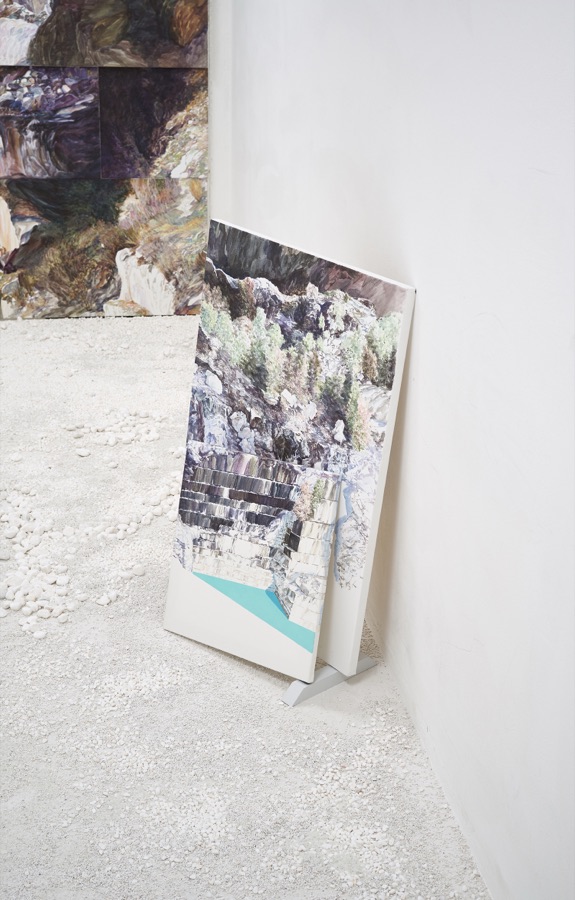
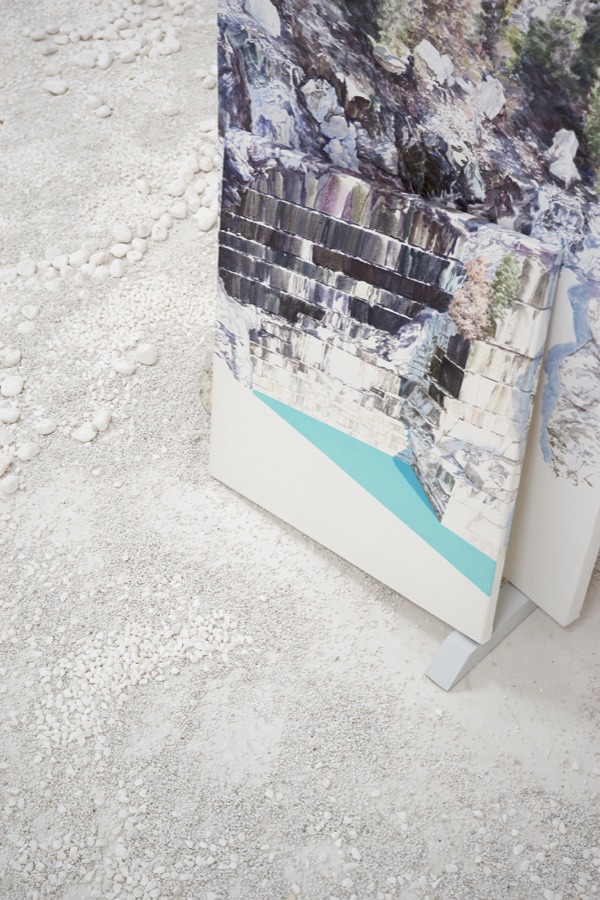
공간형에서 열린 최가영의 개인전 «세르비아의 산, 채석장, венчац»은 세르비아 출신 작가인 지인 ‘M’을 통해서 세르비아의 아름다운 산의 이미지를 jpeg 형식으로 받은 후 페인팅으로 표현한 작품으로 구성되었다. 이 과정에서 작가는 채석장이라는 사실을 나중에 듣게 된다. 산-채석장의 이미지는 작가가 처음에 떠올린 산과 자연의 이미지에서 점점 멀어져가면서, ‘실재하는 장소의 사진을 보고 어디에도 없는 곳’2으로 전시장에 소개되었다. 그러나 이런 정보 없이 보면 전시장에서 산이 아름답게 보이는 사실은 ‘변함없다’. 산에서 깎여나간 부분이 독립적으로 설치된 캔버스로 표현되었지만, 관람자의 눈에는 여전히 아름다운 산의 일부를 그린 것으로 비친다. 노동자나 기계의 부재 때문에, 이 장면은 아직도 산의 모습을 ‘시각적으로’ 유지하고 있다. 따라서 전시 제목에 포함된 채석장은 시각적으로 전달되기 어렵다. 그렇다면 이번 전시에서 채석장은 미흡하게 그려진 것일까? 아니다. 산-채석장은 그의 작품에서 재현의 주제나 소재에 머물지 않는다. 바로 사람들이 경험의 과정 없이 이미지를 시각적으로 받아들이는 방식을 포착한다. 실제로 가보지도 못한 장소의 이미지는 이상적으로 시각화된다. 앞서 언급한―작가 또한 이번 작업에서 참조하는―관광지의 자연경관을 찍은 사진이 그렇다. 그의 작품에서 깎여나간 채석장의 이미지나 흰 바탕으로 드러난 캔버스 평면은 그가 산토카가 꼽힌다.
산의 이미지를 조작하였다는 증거가 아니다. 오히려 작가는 작품을 통해서 오늘날에 전달되는 시각 기록물이 공백을 내포하는 일면을 드러낸다. 이 공백이란 바로 시공간적 공백이다. 눈앞에 바로 있는, 즉 현전하는 것과 달리, 산의 이미지는 먼 곳에서 바라본 이미지로 표현되었다. 최가영 «세르비아의 산, 채석장, венчац» 전시 전경 (사진: 양이언 / 작가 제공) 그 이미지는 국경의 벽 때문에―지금 상황에 비춰본다면 항공편의 감소, 국가적 거리 두기 때문에―보는 사람과 거리가 생길 수밖에 없을 뿐만 아니라 애초부터 거리를 근거로 표상되는 이미지이다. 거리는 거리감을 전달하면서 산-채석장의 관계에, 더 나아가 보고-경험하는 관계에 균열을 만든다. 우리 눈에 채석장이라는 사실은 명료하게 다가오지 않는다. 이는 무엇보다 채석장의 이미지를 떠올릴 때 노동이 먼저 시각화되지 않은 이유 때문에 그렇다. 기계가 움직이는 시끄러운 소리도 들리지 않는 산-채석장에 노동자의 흔적은 보이지 않는다. 그렇다면 노동자는 어디에 있을까? 작가는 노동자의 시선을 페인팅 속의 산-채석장이 아니라 전시 공간을 찾는 관람객의 시선에 거꾸로 반사한다. 관광지 자연의 이미지가 두 가지 의미에서 바라봄에 근거하였고 이는 오늘날의 과정 없는 체험 방식에 더 깊숙이 스며든다. 채석장의 분업 형태, 바로 인간이 기계화되고 어떤 상품 및 소비재로 완성될지 모르는 파편적 노동―기 드보르(Guy Debord) 가 말하는 ‘노동의 분할에서 세분화된 신체 동작’3―은 발터 벤야민(Walter Benjamin)을 경유해서 말하자면 경험(Erfahrung) 아닌 체험(Erlebnis)4으로 자리를 잡게 되었다. 파편적 체험은 결과적으로 산을 향유 대상과 자본―마르틴 파리』, 길, 2010, pp. 216-218 참조 하이데거(Martin Heidegger) 의 말에 따르면 더이상 이용 대상(Gegenstand) 아닌 징용된 물자(Bestand)5―으로 볼 뿐만 아니라 인간의 경험, 나아가 노동 또한 파편으로 만든다. 산-채석장은 거리감과 파편화가 공명하는 자리로 나타난다. 여기서 산-채석장과 인간-노동자의 관계는 미적 향유와 사용가치가 뗄 수 없는 관계망 속에 놓이게 된다. 작가는 이미지(시각 자료)를 아름다움의 이미지(이상적 상)를 바라(보)는 시점에서 지인에게 요청한 뒤 이를 바탕으로 작업하였다. 그가 만든 산-채석장의 이미지(평면 작업)와 공간(전시장)은 관람객의 시선을 파편이 된 시각적 체험-노동으로 이끈다.
과정이 배제된 거리라는 전제를 인지하지 못한 채 관람객은 대상을 익숙한 것으로 받아들인다. 우리가 산이나 채석장을 떠올릴 때 전형적으로 부여되는 특성, 바로 이상적으로 그려지는 시각 기록물이라는 의미의 이미지는 도처에 만연되어 있다. 실제로 그곳을 방문하지 않았는데도 접근할 수 있는 아름다운 경관은 SNS 공간이나 인터넷에 만연되어 있다. 익숙한 이미지는 이번 전시뿐만 아니라 갤러리 도스에서 열린 지난 개인전에서 작가가 다루는 소재이다. «FOUND 쉽게 찾은 풍경»(2017)에서 작가는 아이슬란드를 다녀와서 얻은 인상을 동양화의 ‘전형적인’ 모티프와 함께 재구성하였다. 그 전시 서문의 타이틀에 반영된 것처럼, 이 전시에서 작품은 “어디에도 없는 곳”(김미향)6으로 등장한다. 이번 전시는 지난 개인전 출품작에 부여된 장식적 요소를 덜 반영하여 산-채석장의 모습을 간결하게 보여준다. 그러면서(도) 작가는 이미지의 ‘전형성’을 작품에 포착한다. венчац는 실제로 있지만, 우리는 그곳을 경험하지 못한다. 그 대신 관람자는 자연의 익숙한 이미지, 바로 ‘어디에도 넘치는―앞서 나온 말을 다시 상기시키자면 ‘국경을 초월한’―이미지’를 통해 실제로 접근하는 과정을 막아서면서 거리감 없이 시각 체험을 한다.
«세르비아의 산, 채석장, венчац» 에서 이미지는 ‘깎여 나간’ 특성을 통해서 전형성을 또 다른 방식으로 담보되었다고 볼 수 있다. 특정 지역이 아닌 산의 모습과 소음과 움직임이 사라진 채석장의 모습은 실제를 단순화하여 시각 체험을 통해 우리를 길들인다. 산-채석장을 보는 사람에게 익숙함은 대상과 우리 사이의 거리감을 암암리에 배가시키지만 그것(거리감)을 은폐하면서 획득된다.
산을 바라보는 것과 마찬가지로, 관람객은 ‘헤쳐 들어가는’ 경험 없이 미술 전시를 어떤 경우에 피상적으로 받아들인다. 과정이 생략된 시각 체험에서 실제는 제한적으로 전달된다. 우리가 전시공간을 산이자 동시에 채석장으로 받아들인다면, 얼떨결에 캐내는 무언가를 꺼내 잡을 필요가 있지 않을까―그것은 아마도 (오히려) 손을 내려놓을 수밖에 없는 ‘대상과의 거리감’일 것이다.
최가영 «세르비아의 산, 채석장, венчац» 전시 전경 (사진: 양이언 / 작가 제공)
三つの講演 』森一郎, 講談社学術文庫, 2019 수록) pp. 115-116 found-%EC%89%BD%EA%B2%8C-%EC%B0%BE%EC%9D%80-%ED%92%8D%EA%B2%BD/ 에서 확인할 수 있다.
1 하이쿠는 엄밀히 말하면 5-7-5의 정형시 형식이지만, 이를 탈피하여 자유시를 추구한 인물 중에 다네다
2 «세르비아의 산, 채석장, венчац» 아티스트 노트 참조
3 기 드보르 『스펙타클의 사회』(1967, 木下誠, ちくま学芸文庫, 2003) 25번 테제 참조
4 발터 벤야민, 김영옥 외 역,「보들레르의 몇 가지 모티프에 관하여」,『보들레르의 작품에 나타난 제2제정기의
5 마르틴 하이데거「기술이란 무엇인가」(1953년 강연) (マルティン・ハイデガー『技術とは何だろうか
6 김미향이 쓴 서문 참조. https://www.artbava.com/exhibit/%EC%B5%9C%EA%B0%80%EC%98%81-
패, 경, 옥. 이런 취향의 정체The State of Taste such as Pae, Kyeong, Ok
김현주 (독립큐레이터) · 《인천아트플랫폼 2023 레지던시 프로그램》 도록, 134–139쪽Hyunju KIM (Independent Curator) · Incheon Art Platform Artist-in-Residence Program 2023, pp. 134–139
패, 경, 옥 이런 이국 소녀들의 이름과, …… ‘프랑시스 잠’, ‘라이너 마리아 릴케’, 이런 시인의 이름을 불러 봅니다.
윤동주의 「별 헤는 밤」(1948)은 패(佩), 경(鏡), 옥(玉)과 프랑시스 잠(Francis JAMMES), 라이너 마리아 릴케(Rainer Maria RILKE)를 나누어 이국 소녀들과 시인의 이름이라 읊으나 어린 날 내겐 이 이름 모두 이국의 정취를 불러들였다. 외국(外國)보다 이국(異國)이란 말이 전하는 정서적 거리는 남다르다. 이국 취향의 구성은 단순한 물리적 거리 이상으로 낯섦에서 오는 동경(憧憬)이 도사리고 있다. 사실 실제 거리는 중요하지 않다. 뒤섞여 혼재된 취향이 어떤 정체를 지니는가가 더 중요해 보인다. 혹은 어떤 결정화(crystallization)를 지니는가가 중요해 보인다.
하와이로부터, 세르비아 거쳐, 후르츠로
최가영의 흐름은 세르비아로부터, 하와이 거쳐, 후르츠로가 맞다. 그러나 이 글은 하와이로부터, 세르비아 거쳐, 후르츠로 향하겠다. 내가 최가영을 접하게 된 시간순이다.
하와이로부터
1976년 개장한 경기도 용인자연농원은 1996년 명칭을 변경하여 에버랜드가 됐다. 같은 땅의 테마파크가 ‘삶의 질 향상을 위한 시간과 공간의 무한한 가치를 창조해 나가자’라는 기치로 재편된 것이다. 에버랜드가 꿈과 희망의 터전으로 승승장구하던 때, 자연농원보다 후발주자로 1979년 개장한 경남 창녕군 부곡하와이는 1990년대 이후 쇠락하다가 2017년 폐업하고 말았다. 최가영의 《Survival in Fantasy》에 대해 얘기하려다 사설이 길었다. 《Survival in Fantasy》는 2022년 금호미술관에서 개최된 최가영의 개인전이다. 우연히 전시에 들렀다가 홀연 마음이 흔들리고 말았다. 왜냐면 나는 부곡하와이 키즈다. 99장으로 이루어진 〈아흔 아홉 조각의 부곡하와이-1984년 J로부터〉(2022)를 들여다보며 스테이지(무대라는 말보다 이국 취향이 점철된 스테이지가 이 순간에는 더 적절하다) 위에서 춤추던 무용수들을 넋 놓고 바라보던 어린 날로 회귀했다. 최가영이 이베이(eBay)에서 우연히 찾은 J(재키 Jacky)의 엽서로부터 점화된, 99장으로 쪼개어진 그 시절 부곡하와이. 화려하고 현란했던 그 무대, 온갖 열대 식물로 꾸며진 그 공간, 돌고 도는 미온수를 따라 알록달록 수영복을 입었던 그때 그 사람들, 나름 긴 길이를 자랑하던 그 물미끄럼틀(워터슬라이드로는 설레임을 녹여내기 어렵다)이 99장으로 조각난 회화로부터 서로 엉겨 붙으며 되살아났다. 이 작품은 마치 렌티큘러(lenticular)처럼 아롱 어른거리는 이미지가 간격을 두고 배열되어 있었는데 간격이 되는 흰 배경이 기억의 틈바구니가 되어 오히려 실제와 상상이 뒤엉킨 그날들을 연상시켰다. 이처럼 내겐 구체적 경험이 최가영의 회화를 통해 복기되었다면, 최가영에겐 상상의 장소가 J의 엽서와 낮은 화질로 기록된 부곡하와이 홈비디오를 통해 구성되어 입체화되었다. 물론 그녀는 “점점점 뭔가 상상의 두께가 이렇게 쌓이는 것 같은 경험……그럼에도 불구하고 이 경험의 공백은 절대 채워질 리가 없겠구나” 싶었다고 말했다. J로부터 촉발된 이국 취향이 다시금 무대 위에 재상연되었지만, 만나본 적 없는 J를 비롯한 그 시절 사람들 대신 열대 식물이 그 의미를 대신했다. 폐장 전에 한 번쯤은 최가영이 닿을 법도 했을 부곡하와이는 옅은 시차를 두고 그녀와 벌어지고 말았고 부곡하와이에 대한 인터뷰가 회화 앞면에서 채 다루지 못한 기억을 뒷면에서 벌충하는 구조를 취했다.
세르비아 거쳐
이보다 앞선 2020년 공간형에서 열린 최가영의 개인전 《세르비아의 산, 채석장, Венчац》(공간 형, 서울, 2020)에 대해서도 할 말이 있다. 프랑스, 독일, 영국 이런 나라보다 세르비아라니! 외국이라 하기엔 이국에 더 가깝지 않은가. 세르비아 벤차스 채석장을 그린 최가영의 《세르비아의 산, 채석장, Венчац》를 보면서도 말문이 막혔다. 부곡하와이가 나와 최가영 사이 세대에 빗금을 긋는다면, 세르비아는 그곳에 방문한 적 있는 나와 나 이외의 사람들을 무리 짓는다. 나만의 특수한 경험이라고 하기엔 다소 무리가 있지만 세르비아 남부 작은 마을에서 열린 결혼식에 초대받아서 에밀 쿠스트리차(Emir KUSTURICA, Емир КУСТУРИЦА) 영화에 나올법한 춤을 췄던 날이 있다. 그런데 정작 《세르비아의 산, 채석장, Венчац》의 당사자 최가영은 그곳에 가본 적이 없었다. 오히려 이 전시를 계기로 2023년 가을 세르비아에서의 전시가 성사됐다. 이 전시는 세르비아 작가 M(마리아 Maria)으로부터 현지 사진을 받아 사진 속 산을 직접 걷고 둘러본다는 기분으로 회화를 그리던 것이 계기가 됐다. 그러나 뒤늦게 사진 속 풍경이 채석장임을 알게 됐을 때 받은 충격은 어마어마하다. 최가영은 “그 산이 와르르 무너지는 느낌”을 받았다고 한다. 아마도 이 인식을 계기로 전후 전시를 준비하는 마음이 각기 다르지 않았을까. 아무튼 그것이 야산이든 채석장이든 전송된 이미지를 모니터상에서 보고 구성한다는 건 달라지지 않은 조건이었다. 현장에서는 엄청난 양감과 질감을 지니고 있겠지만 픽셀로 현시된 풍경은 공간의 전경과 원경이 실제보다 다닥다닥하게 붙어 “표면이 납작하게 쌓여” 회화로 드러났다. 이 표현 방식을 위해 한지 대신 캔버스에 아크릴릭을 시도하게 됐다. 물론 변화된 시도 그 자체가 지닌 의미도 있지만 최가영은 변화보다는 원하는 표현에 방점을 찍은 듯하다. 그녀에게 회화의 지지체나 안료, 붓 같은 도구는 효율을 재고하기 위해 동반되지는 않는다. 여전히 그녀에겐 동양화의 기초 개념이 중요하게 작동한다. 그렇기 때문에 회화에서는 확실히 면보다 획이 도드라진다. 필력을 통한 움직임과 속도감은 그녀에게 캔버스에 아크릴을 쓰더라도 지속된 과제인데 경험하지 못한 산수에 적합한 표현을 위해 필요에 따라서는 유연한 선택을 취했다. 가상의 풍경도 가상임을 드러낼 수 있는 표현 방식에 따라 변화를 취했기에 회화의 표면은 불연속적인 풍경을 취하는 과정에서 선택하게 된 생략, 분절, 병치, 조합을 과감히 드러냈다. 세르비아 전시 이후 그녀로부터 물리적으로는 처음, 개념적으로는 두 번째 다가선 그곳을 남긴 몇 장의 기록사진을 받았다. 아직 끝나지 않은 이국의 단편이 최가영에게 앞으로 어떤 원료가 될지 지켜볼 예정이다.
후르츠로
2023년 가을 개최된 최가영의 개인전 제목은 《후르츠》(갤러리조선, 서울, 2023)다. 직설적으로 후르츠라니. 과일도 프룻(Fruit)도 아닌, 후르츠라면 제일 먼저 연상되는 건 후르츠칵테일이다. 80년대 병문안의 상징. 단물에 담겨 있는 파인애플, 체리를 제외하고선 사실 과일 각각의 이름도 몰랐었다. 찾아보니 파파야, 코코넛 젤리 등이 들어있다고 한다. 요즘이야 제철 과일에다가 유기농을 찾지만, 열대과일이야말로 이국 취향 저격에 적합하지 않았던가. 부곡하와이, 세르비아 채석장, 후르츠로 이어지는 최가영의 연대기는 이처럼 이국 취향이란 표현에 적격이다. 그러나 그녀는 따뜻한 나라 휴양지에서 환상적인 안식에 취하기를 허하지 않고서 삐딱선을 탄다. 이국 취향의 행복감에 젖도록 허하지 않고 끝내 불편하게 말이다. 실제로 《후르츠》에 등장하는 과일들은 열대과일이라고 하기엔 석연치 않다. 트로피컬(Tropical) 맛이라고 소개하는 명명도 성분을 낱낱이 따져보면 열대와는 전혀 상관없는 곳들에서 비롯한다고 한다. 하와이안 피자의 주된 토핑인 파인애플 또한 미국 자본이 하와이에 진입하면서 재배하게 된 과일로써, 오히려 하와이 왕국을 무너뜨린 산물이라는 것이다. 그렇다면 정물화처럼 진열된 《후르츠》에서 늘어놓은 과일들은 그녀에게 어떤 의미인가. 최가영은 이를 자본이 투입되어 인위적으로 조장된 산업 환경에서 이 과일들이 각자도생하는 가운데 조성된 과일에 대한 현대식 사군자로 간주한다. 사군자라면 동양화과 출신으로서 매난국죽의 상징을 모를 리 없다. 그러나 사군자의 덕목이 동시대상과 거리가 있기에 동시대의 면면을 비출 새로운 제재가 요청되기 마련이다. 특히 《후르츠》의 과일들 중 용과는 화려한 외양에 비해 속내는 은은한 단맛이 있다. 최가영은 이같은 측면으로부터 외양과 내면의 불일치를 포착해 냈다. 몬스테라의 경우 실내 장식을 위해 이용되다 보니 이식된 장소에서의 생존을 발휘해 진화한 외양이 핵심이다. 그녀가 이입하는 지점은 환경과의 불일치 속에서도 생존술을 발휘해야 하는 과일들과 인간의 조건이 지닌 동질감이다. 이 과정에서 작가의 시선이 염세적인지 혹은 냉각화된 관점인지 물었을 때 답변은 단순했다. 그녀는 “귀엽게 보는 편”이라고 응수하는데 연민과 이입, 못마땅함이 혼재된 복잡한 마음이 기저에 깔려 인간의 비인간적인 면모를 추출하고 반대로 비인간의 인간적인 면모 또한 역전해서 생각해 볼 과제로 남긴다. 하와이로부터, 세르비아 거쳐, 후르츠까지 “사람 없지만 사람이 중요한 그림”, 그녀를 수식하는 이 지대가 설득력 있게 다가온다.
이국 취향의 정체
그렇다면 외양에서는 이국 취향이 전면화되고 있지만 이국 취향을 내세우면서 배격하는, 이 꼬여 있음의 이유는 무엇일까. 거리감을 확보한 후에야 도입될 수 있는 최가영의 주제 의식이 무엇인가 묻지 않을 수 없었다. 그녀는 후르츠를 빗대어 “멀리서 온 이방인”이란 표현을 썼다. 동어반복적인 반성의 관성을 벗어나기 위한 거리 설정이 습관이 되었다는 말에 설득당했다. 비판철학이 지닌, 외연에서부터의 인식의 재구성을 내면화한 반성적 사고는 낭만과 이상화를 재고하게 만든다. 부곡하와이처럼 쇠락해서 지나간 여흥의 문물을 흘려버리지 않고 되잡기, 산수화를 대체할 현대의 풍경화가 사생 아닌 모니터 속 픽셀로 재구성되는 회화적 관습 비틀기, 정물에 반영되는 제국주의와 자본주의의 생산과 소비의 세태에 대한 문제 제기. 이들 각각은 피부에 닿지 않음에도 감각하고 있다는 착시와 오인의 부산물을 문제시한다. 최가영은 환상과 이상화가 인간 비인간 모두의 반쪽짜리 생존술임을 주제적 측면에서 일관성 있게 지적하면서도 화가로서의 회화적 과제는 완수와 과제 재설정의 연결고리를 지어가며 나아가고 있다. 회화 이미지가 전하는 직접적인 감각으로 인해 개인전마다 그녀의 주제가 선명하게 전달되고 있는가에 대해서는 고민이 들기도 하지만 중첩되어가면서 연이은 화가로서의 과업 수립에 대해서 기대하는 바가 크다. 예컨대 최가영은 화가지만, 내겐 영화감독처럼 다가오는 면모가 있다. 전시마다 단락이 설정되는 게 아니라 연결된 세계관 아래 하나의 전시에서는 흘러가는 단적인 장면이나 대상일지라도 예리한 시선에 의해 줌 인(zoom-in) 되고 이로부터 스핀오프(spin-off)가 발생하는 연속성이 그녀만의 저력이지 않을까. 이국 취향의 정체(正體)는 심장의 수축과 이완이 그러하듯 살아있는 한 움직임을 지닌다. 정체(停滯) 아닌 방식으로 나아간다.
김현주는 예술의 선물과 증여 가치에 대해 고민한다. 정체성을 폐업 큐레이터에 두고 있고, 일이 있을 때만 잠깐씩 전시를 만들고 글을 쓴다. 사회적 쟁점, 사회적 소수자의 문제에 예술로 개입하고자 하며, 정주보다는 유목적 활동에 관심을 갖는다.
I call for each star Pae, Kyeong, Ok, such foreign girls’ names, ...... names of poets like ‘Francis JAMMES,’ Rainer Maria RILKE’
In YUN Dongju’s “A Night of Counting Stars,” he categorizes the names of exotic girls and poets as Pae (佩), Kyeong (鏡), Ok (玉), and includes figures like Francis JAMMES and Rainer Maria RILKE. However, during my childhood, all these names carried a sense of the exotic. The emotional gap conveyed by the term “exotic” surpassed that associated with a foreign country. Exotic taste is composed not only of physical distance but also of the yearning arising from unfamiliarity. In reality, the actual physical distance is inconsequential. What holds more significance is the kind of identity or crystallization that these blended tastes possess.
From Hawaii to Serbia to Furutsu
CHOI Kayoung’s journey spans from Serbia to Hawaii and eventually Furutsu. However, for the purpose of this essay, I will trace the narrative in reverse chronological order—from Hawaii to Serbia and, finally, to Furutsu. This sequence mirrors the order I was introduced to CHOI.
From Hawaii
The Yongin Natural Farm, established in Gyeonggi Province in 1976, underwent a transformation in 1996, rebranding itself as Everland. The theme park, situated on the same grounds, underwent a reorganization aimed at “Creating the infinite value of time and space to improve the quality of life.” While Everland ascended as a haven of dreams and aspirations, Bugok Hawaii in Changnyeong-gun, Gyeongnam, inaugurated in 1979 as a belated counterpart to the natural farm, experienced a decline post-1990s, culminating in its closure in 2017. This sets the backdrop for the discussion of CHOI’s exhibition Survival in Fantasy. Survival in Fantasy was CHOI’s solo exhibition at the The Kumho Museum of Art in 2022, a showcase that left a profound impact on me when I happened upon it by chance. As a child hailing from Bugok Hawaii, delving into the 99 chapters of Ninety-nine Pieces of Bugok Hawaii - From J in 1984 (2022) transported me back to the enchanting days of watching dancers perform on a stage filled with exotic allure. These memories, ignited by a postcard of J (Jacky) discovered by CHOI on eBay, unveiled the vividly colorful and glamorous stage adorned with various tropical plants, people adorned in vibrant swimsuits beside swirling lukewarm water, and an exceptionally long water slide, evoking a profound sense of nostalgia. The work took the form of a lenticular arrangement, presenting shimmering images at intervals against a white background that served as a gap in the memory, echoing those days when reality seamlessly intertwined with the imagined. While CHOI’s paintings evoked concrete experiences, for her, the imaginary realms were constructed through J’s postcards and low-quality home videos of Bugok Hawaii. She expressed, “I felt that the gap in my imagination would never be filled, even though the thickness of the imagination seemed to be building up like this...” The exotic allure sparked by J was once again brought to the forefront, yet instead of people from that era, including J whom she had never met, tropical plants assumed their place. Despite the slight time lag that separated CHOI from Bugok Hawaii, an interview with the remnants of Bugok Hawaii was structured to bridge the gaps in her memory embedded behind the paintings.
Through Serbia
There is also something to be said for CHOI’s solo exhibition A Serbian Mountain, a Quarry, Venčac at Art Space Hyung in 2020. Serbia is more like a foreign country than France, Germany, or England. I was speechless when I saw CHOI’s A Serbian Mountain, a Quarry, Venčac, which depicts the Benzas quarry in Serbia. If Bugok Hawaii draws a line in the sand between me and CHOI, Serbia draws a line in the sand between me and anyone else who has ever been there. I wouldn’t call it a unique experience, but there was a time when I was invited to a wedding in a small town in southern Serbia and danced a dance that looked like something out of an Emir KUSTURICA movie. CHOI, who is the subject of A Serbian Mountain, a Quarry, Venčac, had never been there. Rather, this exhibition led to an exhibition in Serbia in the fall of 2023. The idea for the exhibition was to receive local photographs from Serbian artist M (Maria) and paint them with the idea of walking and exploring the mountains in the photographs. However, she was shocked when she later realized that the landscape in the photo was a quarry. “I felt like the mountain was crumbling,” CHOI said. Perhaps this realization led to different preparations for the postwar exhibition. Regardless of whether it was a mountain or a quarry, the conditions for viewing and composing the transmitted image on a monitor were the same. While they may have had tremendous texture and color in the field, the pixelated landscapes appeared as paintings with “flattened surfaces” that made the foreground and background of the space appear closer together than they actually were. For this expression, she decided to try acrylic on canvas instead of hanji. Of course, the change has its own meaning, but CHOI seems to have focused on the desired expression rather than the change. For her, the tools of painting, such as support, pigment, and brushes, do not accompany her to rethink efficiency. The basic concepts of Oriental painting are still important to her. Therefore, in her paintings, strokes are definitely more prominent than surfaces. The sense of movement and speed through handwriting is a constant challenge for her, even with acrylics on canvas, and she makes flexible choices when necessary to find the right expression for the landscape she has not experienced. The surface of the paintings boldly reveals the omissions, fragmentation, juxtapositions, and combinations she chose to make in the process of taking in the discontinuous landscape, as the fictional landscape was altered in a way that could reveal its fictional nature. After the exhibition in Serbia, I received from her a few archival photographs of the place she had approached for the first time physically and for the second time conceptually. It will be interesting to see what these unfinished fragments of a foreign country will provide for CHOI in the future.
To Furutsu
CHOI Kayoung’s solo exhibition in the fall of 2023, titled Furutsu (Gallery Chosun, Seoul, 2023), conjures images of canned fruit cocktail, a symbol of 80s hospital visits. Aside from the pineapple and cherry in the honeydew, I didn’t even know the names of the individual fruits. When I looked it up, I found out that it contains papaya, coconut jelly, etc. Unlike the trend of seeking seasonal and organic fruits today, tropical fruits are the best for savoring exotic tastes. CHOI’s chronicle of Hawaii, Serbian quarries, and furutsu is a perfect example of embodying exoticism. However, rather than basking in the euphoria of exoticism, she brings forth discomfort. The fruits featured in Furutsu are not truly tropical, and even the flavors labeled as “tropical” originate from places unrelated to the tropics upon closer examination of the ingredients. Pineapple, a central element of Hawaiian pizza, was introduced to Hawaii with American capitalism and represents the cause of the Hawaiian kingdom’s collapse.
If that’s the case, what does the array of fruits displayed in Furutsu, arranged like still life paintings, mean to her? CHOI Kayoung considers these fruits as contemporary still lifes, each coexisting in an environment artificially stimulated by capital. As a trained Oriental painter, CHOI is undoubtedly familiar with the symbolism of the Four Gentlemen – plum, orchid, bamboo, and chrysanthemum. However, given that the virtues of the Four Gentlemen are distant from contemporary concerns, new perspectives are often required to shed light on contemporary issues. Among the fruits in Furutsu, the dragon fruit, despite its vibrant appearance, possesses a subtle sweetness. CHOI skillfully captures the disparity between external and internal qualities. For the monstera, its aesthetic appeal as an interior decoration contrasts with its evolution to adapt and survive in a transplanted environment. Her exploration delves into the homogeneity between fruits and the human condition, emphasizing the necessity for survival skills in the face of environmental discrepancies. When asked if her perspective on this process is pessimistic or cynical, CHOI simplifies it by saying, “I tend to look at them as cute.” However, beneath this simplicity lies her complex feelings of compassion, understanding, and disgust, revealing the inhumanity of humans while challenging viewers to contemplate humanity within non-human entities. From Hawaii to Serbia to Furutsu, where “there are no people in the picture, but people are important,” CHOI’s formulated artistic space is convincingly thought-provoking.
The Statis/Stagnation of the Exotic Taste
Why, then, is there this twist, where exotic tastes take center stage externally but are ostracized internally? I couldn’t help but ask what is CHOI’s consciousness which can only be introduced after securing distance. She used the expression “stranger from afar” in reference to Furutsu. I was convinced by her assertion that maintaining a distance had become a habit to break free from the inertia of repetitive reflection. Reflective thinking, inherent to critical philosophy, involves internalizing the reconstruction of perception from external sources, prompting us to reconsider romanticization and idealization. Choosing to reclaim a deteriorating artifact of entertainment like Bugok Hawaii instead of letting it fade away, altering painterly conventions as modern landscape painting transforms into pixels on a monitor instead of a portrayal of life, and questioning the systems of production and consumption rooted in imperialism and capitalism as reflected in still life—all these endeavors address the byproducts of illusion and misperception. They highlight the illusion that we are sensing something even when it doesn’t physically touch our skin. While CHOI consistently emphasizes that illusion and idealization are half-hearted survival techniques for both humans and non-humans, her painterly task, as an artist, is one of completion and resetting. Despite occasional concerns about whether her themes are clearly conveyed in each solo exhibition due to the direct sensation conveyed by her painted images, I have high expectations for the overlapping and successive establishment of her tasks as a painter. CHOI, to me, resembles more of a filmmaker than just a painter. The continuity in her work, where even a single scene or object from one exhibition becomes the focal point of a connected worldview, exhibits her strength. The stasis of exoticism carries a living movement, much like the contraction and relaxation of the heart, moving forward in a way that avoids stagnation.
Hyunju KIM contemplates the gift value of art as an alternative to the commercialization of art. She intends to intervene as an art in social issues and problems of social minorities, and is more interested in nomadic activities than settlement.